Why You Hold Your Breath in Wall Pilates (and How to Stop)
Quick Answer: Wall pilates makes people hold their breath because the wall provides a fixed reference point that invites bracing, and bracing recruits the same muscles you’d use to exhale. The fix is to exhale on the effort phase - pressing into the wall - and to keep your ribs moving sideways rather than your belly moving up.
You notice it about eight minutes in: you’re gripping, your jaw is tight, and you haven’t taken a real breath in three reps. Wall work is unusually good at causing this, and there’s a specific mechanical reason why.

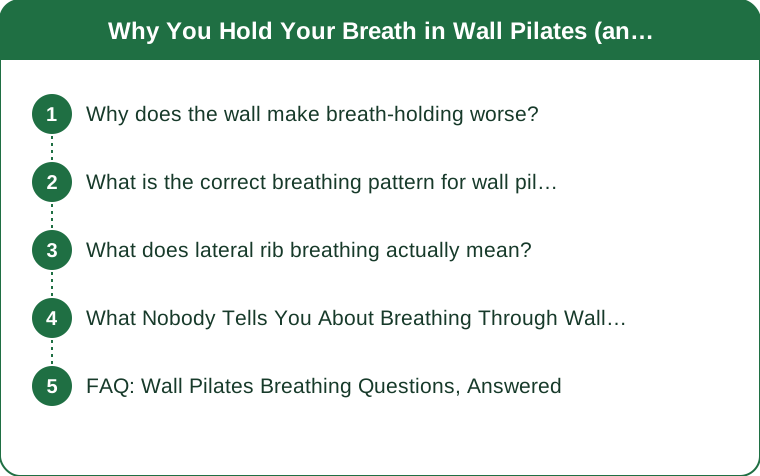
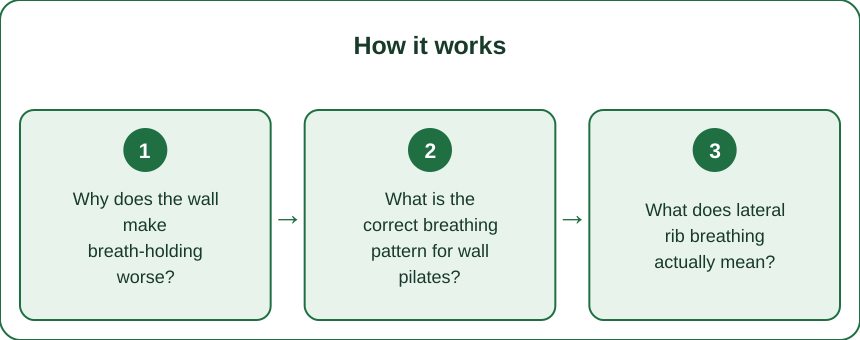
Why does the wall make breath-holding worse?
On a mat, there’s nothing to push against, so your body has no strong invitation to brace. Push your feet into a wall and your nervous system does what it does with any fixed resistance - it stiffens the trunk to transmit force.
That stiffening is a Valsalva-like response: closing the throat and pressurizing the abdomen to create a stable core. It’s genuinely useful for a heavy deadlift. It’s counterproductive for wall pilates, where you want sustained, controlled tension rather than a single peak effort.
The wall also gives you unusually precise feedback about position, which makes people concentrate harder. Concentration itself reduces breathing rate - the same reason you hold your breath threading a needle.
What is the correct breathing pattern for wall pilates?
The general rule: exhale on the effort phase, inhale on the return.
Pressing your feet into the wall in a bridge? Exhale as you press up. Lowering back down? Inhale. Drawing your knees toward your chest against wall resistance? Exhale on the draw.
The reason isn’t arbitrary. Exhaling naturally engages your deep abdominal wall - the transverse abdominis - which is exactly the muscle wall pilates is trying to teach you to find. Exhaling on effort means the core engagement happens automatically instead of being something you consciously clench.
Count it out loud for the first two weeks. Say the exhale count aloud - ‘two, three, four’ - which makes breath-holding physically impossible. It feels ridiculous and it works faster than any cue about awareness.

What does lateral rib breathing actually mean?
Pilates breathing is often described as ‘lateral’ or ‘ribcage’ breathing, which confuses people who’ve been told for years to breathe into their belly.
Here’s the practical version: put your hands on the sides of your lower ribs. As you inhale, your ribs should widen sideways into your hands, like an umbrella opening. Your belly should stay relatively quiet.
Why this matters for wall work: belly breathing pushes your abdominal wall outward, which is the opposite of the deep core engagement wall pilates is building. Lateral breathing lets you take a full breath while maintaining that engagement, which is the only way to breathe continuously through a long hold.
If you can’t feel the sideways movement, lie with your feet on the wall, wrap a towel around your lower ribs, hold the ends crossed in front, and breathe into the towel. The tactile feedback teaches it in one session.
What Nobody Tells You About Breathing Through Wall Holds
Your first breath after a hold tells you everything. If you gasp, you held. If it’s an ordinary breath, you didn’t. This is a better self-audit than trying to monitor yourself mid-exercise, because monitoring changes what you’re measuring.
Jaw tension is the early warning. Almost nobody clenches their jaw and breathes freely at the same time. If you notice your teeth together, your breath is already gone. Let your tongue rest on the roof of your mouth and your jaw follows.
Breath-holding makes holds feel shorter and be worse. You’ll manage 30 seconds while holding your breath and feel like you crushed it, but the muscles you were supposed to be training got a pressure wave rather than sustained tension. A 20-second hold with continuous breathing does more.
Blood pressure genuinely rises during breath-holding under exertion. For most healthy people this is a brief, harmless spike. If you have high blood pressure, cardiovascular concerns, or you’re pregnant, continuous breathing isn’t just better technique - it’s the safer choice, and worth mentioning to your doctor. This is general information, not medical advice.
It comes back under fatigue. You’ll fix it in week two and lose it again in week five when the exercises get harder. That’s normal. The out-loud counting trick is worth keeping in your back pocket permanently.
FAQ: Wall Pilates Breathing Questions, Answered
Should I breathe through my nose or mouth?
Most pilates traditions cue inhaling through the nose and exhaling through the mouth, which naturally slows the exhale. Either works - consistency matters more than the route.
What if breathing this way makes me dizzy?
Stop, breathe normally, and reduce the depth. Dizziness usually means you’re over-breathing rather than under-breathing. The breath should be full, not forced.
Does breath timing really change results?
For core engagement specifically, yes - exhaling on effort measurably increases deep abdominal activation. For general strength, timing matters less than simply not holding it.
TL;DR:
- The wall invites bracing, and bracing invites breath-holding
- Exhale on the effort phase, inhale on the return - this engages your deep core automatically
- Breathe laterally into your lower ribs, not up into your belly
- Count your exhale out loud for two weeks; it makes holding impossible
- Jaw tension is the early warning sign, and your first breath after a hold is the honest audit
The wall is better feedback than a mat. It’s just also better at teaching you to freeze.
See It in Motion
Seen here: High Waist Bootcut Yoga Pants with Hidden Pocket — shop it on bubblelime.com
Keep Reading
This article is for general informational and styling purposes only. Fit, sizing, and product availability may vary.