The Wall Contact Point Mistake That's Making Wall Pilates Feel Ineffective
Quick Answer: Wall Pilates relies on specific contact points (usually the sacrum, shoulder blades, and heels pressing into the wall simultaneously) to create the resistance and alignment feedback that makes the exercises effective. Skipping even one contact point — a common issue with rounded lower backs pulling away from the wall — turns the same movement into a much lower-effort version of itself.
You followed the video exactly, same reps, same tempo. Still feels like nothing. The gap almost always isn’t effort — it’s whether your body is actually maintaining full wall contact throughout the movement, not just at the starting position.
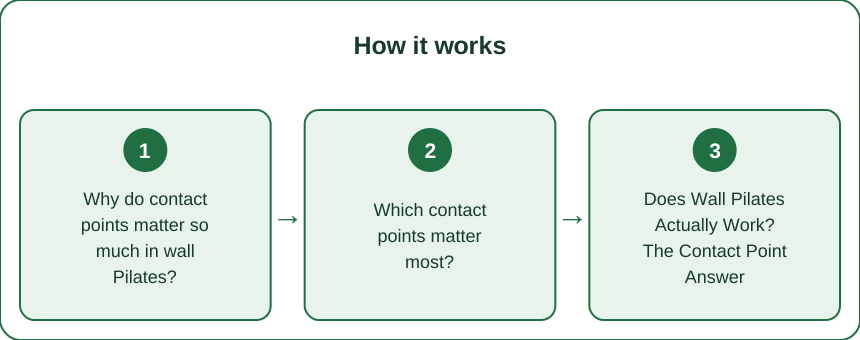
Why do contact points matter so much in wall Pilates?
The wall isn’t just a reference point — it’s providing the resistance and feedback that a mat version of the same exercise would otherwise rely on core strength alone to achieve. When your lower back rounds away from the wall (a very common compensation during leg lifts or bridges), you lose that resistance and the exercise reverts to a much easier, less effective version of itself.
Most ‘wall Pilates isn’t working’ complaints trace back to losing contact partway through a rep, not at the start where it’s easiest to check form.
Which contact points matter most?
For most standard wall Pilates moves: sacrum (lower back/tailbone area), shoulder blades, and back of the head should stay pressed into the wall throughout, not just at rest. For standing or leg-based exercises, heels staying grounded and in contact with the floor-wall junction matters just as much.
A simple self-check: if you can slide a hand behind your lower back at any point during the movement, that contact point has already been lost.
Does Wall Pilates Actually Work? The Contact Point Answer
Wall Pilates can be genuinely effective for core and postural strength specifically because of the contact-point resistance — it’s not a lesser version of mat Pilates, it’s a different resistance mechanism. But that effectiveness is conditional on maintaining contact, which is exactly the detail most short-form videos don’t have time to explain.
Myth vs Fact: Wall Pilates Edition
Myth: Wall Pilates is easier than mat Pilates. Fact: When contact points are properly maintained, wall Pilates can be just as challenging — the wall adds resistance and immediate feedback rather than removing difficulty.
Myth: Any wall works the same way. Fact: A textured or padded wall changes the tactile feedback you rely on to sense contact — a smooth, flat wall gives the clearest feedback for beginners learning to feel contact points.
Myth: If you can do the movement, your form is correct. Fact: Completing the range of motion while losing contact partway through is common and looks similar on video, but delivers a meaningfully different (weaker) training effect.
FAQ: Wall Pilates Questions, Answered
How do I know if I’m losing contact during a movement?
Record yourself from the side, or have a mirror positioned to check your lower back’s distance from the wall at the midpoint and end of each rep, not just the start.
Is wall Pilates suitable for beginners with weak cores?
Yes — the wall’s feedback often helps beginners learn correct alignment faster than an unsupported mat version, provided contact points are checked regularly early on.
Can wall Pilates replace a full pilates or strength routine?
It’s a strong complement for core and posture work, but a well-rounded routine typically still benefits from added lower-body and upper-body strength work beyond what wall-based moves alone cover.
TL;DR:
- Wall Pilates effectiveness depends on maintaining sacrum, shoulder blade, and heel contact throughout the movement, not just at the start
- Losing contact partway through a rep is the most common reason it ‘feels like nothing’
- Wall Pilates isn’t an easier version of mat Pilates — it’s a different resistance mechanism
- Check contact points on video or in a mirror, not just by feel
Next session, focus entirely on maintaining contact through the full rep — the same movement will suddenly feel noticeably harder.
See It in Motion
Seen here: High Waist Bootcut Yoga Pants with Pockets — shop it on bubblelime.com
Keep Reading
This article is for general informational and styling purposes only. Fit, sizing, and product availability may vary.