Is It Actually Safe to Anchor a Resistance Band to Your Door Frame for Wall Pilates?
Quick Answer: A standard interior door frame is not engineered to bear repeated pulling load, and while a light resistance band at low tension is often fine on a sturdy frame, higher-tension bands or frequent use can gradually loosen trim, crack paint, or in older or hollow-core frames, cause real structural damage — a dedicated door anchor attachment designed to distribute load across the frame, or a wall-mounted anchor point, is the safer long-term choice.
It seems like the perfect solution: no extra equipment, no drilling, just loop the band around the door frame and go. Whether that’s actually a safe habit depends on more than it looks like at first glance.

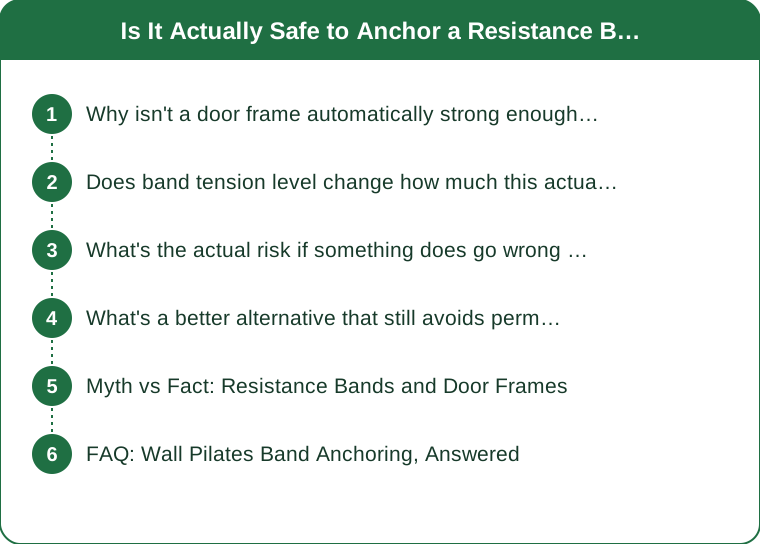
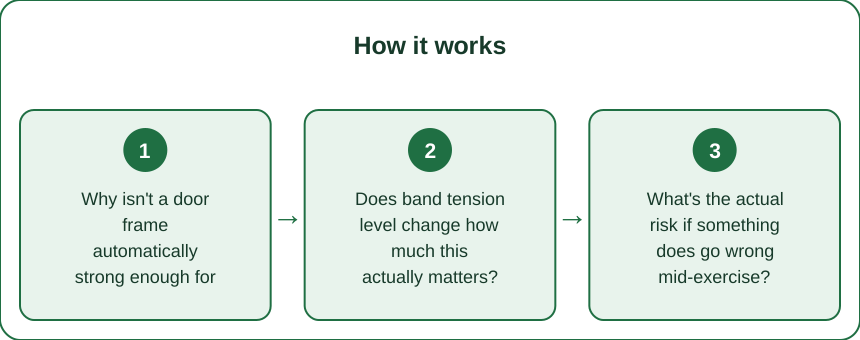
Why isn’t a door frame automatically strong enough for this?
Interior door frames are built to support the door itself and light everyday contact, not repeated pulling force concentrated at one point. A resistance band looped directly around bare trim concentrates tension on a narrow strip of wood or the frame’s attachment to the wall, which is a very different load pattern than what the frame was designed to handle.
Does band tension level change how much this actually matters?
Significantly — a light or medium resistance band used for gentle wall pilates movements applies relatively low sustained force, which most solid frames handle without issue over occasional use. Heavy resistance bands, or frequent daily use even at moderate tension, apply cumulative stress that’s more likely to gradually loosen trim or, on hollow-core or older frames, create real damage over time.
What’s the actual risk if something does go wrong mid-exercise?
Beyond property damage, if a band anchor point suddenly gives way under tension, the band can snap back toward you with real force, which is a genuine injury risk, not just an inconvenience. This risk is part of why door frame anchoring, while common, isn’t universally recommended by trainers even when the frame itself seems sturdy.

What’s a better alternative that still avoids permanent installation?
Dedicated door anchor attachments — a padded strap or bracket specifically designed to sit at the top of a closed door and distribute load across the door itself rather than the frame — are inexpensive and purpose-built for this exact use case, spreading force more safely than a bare band looped around trim.
Myth vs Fact: Resistance Bands and Door Frames
Myth: If the frame looks sturdy, it’s fine for any resistance band tension. Fact: sturdiness alone doesn’t tell you how the frame handles concentrated, repeated pulling force, which is a different stress pattern than normal use.
Myth: A door anchor attachment is basically the same as looping the band directly. Fact: a dedicated anchor distributes force across the closed door’s full width rather than concentrating it on trim.
Myth: This only matters for heavy resistance bands. Fact: frequent use at any tension adds cumulative stress, so even lighter bands used daily are worth reconsidering on an older or hollow frame.
FAQ: Wall Pilates Band Anchoring, Answered
Is a permanently wall-mounted anchor point actually better?
Yes, generally — a wall anchor installed into a stud, rather than a door frame, distributes and handles load far more reliably for regular or higher-tension use.
How do I know if my door frame is hollow-core versus solid?
Knocking on the frame near where you’d anchor a band gives a rough sense — a hollow, drum-like sound suggests a hollow-core frame less suited to load-bearing use.
Should I stop anchoring bands to door frames entirely?
Not necessarily for occasional, light-tension use on a solid frame, but a dedicated door anchor attachment removes the guesswork and meaningfully reduces both damage and injury risk for regular practice.
TL;DR:
- Interior door frames aren’t engineered for the concentrated, repeated pulling force a resistance band applies
- Light bands on a solid frame are usually fine occasionally; heavy bands or frequent use raise real risk
- A sudden anchor failure mid-exercise is a genuine injury risk, not just a property concern
- A dedicated door anchor attachment distributes load far more safely than looping a band around bare trim
The convenience is real, but a five-dollar door anchor attachment removes a risk that’s easy to overlook until something gives way.
See It in Motion
Seen here: Crewneck Short Sleeve Workout T-Shirt — shop it on bubblelime.com
Keep Reading
This article is for general informational and styling purposes only. Fit, sizing, and product availability may vary.