Wall Pilates Bridges Hurting Your Neck? Here Is What Is Actually Wrong
Quick Answer: Neck strain in a wall pilates bridge almost always comes from three things: pushing the head back into the mat instead of letting it rest, setting your feet too far up or too far from the wall so you have to arch to reach, and lifting fast enough that the shoulders and neck brace to help. Fix it by keeping the chin lightly tucked with the back of the skull heavy, positioning your feet so knees stack over ankles at the top, and lifting over a slow three-count from the ribs down rather than from the hips up.
You are supposed to feel this in your glutes and hamstrings. Instead you finish the set rubbing the back of your neck, wondering what you did wrong.
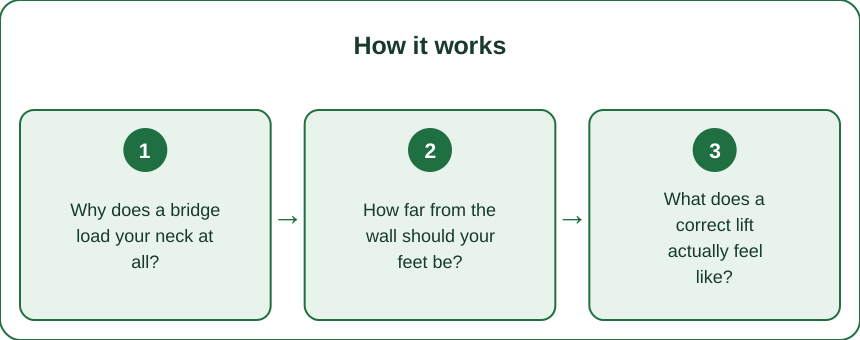
Why does a bridge load your neck at all?
A bridge is a closed chain. Your feet are fixed on the wall and your shoulders and head are fixed on the mat, which means every bit of force you generate travels to both ends.
When your glutes and hamstrings are doing their share, most of that force exits through the feet. When they are not, your body finds another anchor, and the nearest available one is the upper back, shoulders, and neck. You end up pressing the back of your skull into the mat to create leverage.
That is why the fix is rarely a neck stretch. The neck is compensating for something happening 18 inches south of it.
One quick diagnostic: place two fingers lightly under the back of your head as you lift. If your head presses into your fingers, you are anchoring through your neck. The head should stay heavy and passive the entire time.
How far from the wall should your feet be?
The most common setup error is planting the feet too high on the wall, which looks impressive and forces your lower back into an arch to make up the distance.
Set up so that at the top of the bridge, your knees are stacked directly over your ankles and your shins are roughly parallel to the floor. From the mat that usually means hips about the length of your own shin away from the wall, feet at roughly hip height on the wall surface.
If your feet are too close, you cannot generate hamstring tension and the movement becomes a pure lower-back arch. If they are too far, your feet slide and your hip flexors take over.
Test it before adding reps. Lift once, hold, and look down your body. If you can see your toes past your knees, slide closer to the wall. If your knees are well past your toes, slide away.
What does a correct lift actually feel like?
Start by exhaling and pressing your lower back gently into the mat. Then peel up one vertebra at a time from the tailbone, not by throwing the hips at the ceiling.
Count three seconds up. At the top, your body should be a straight ramp from knees to shoulders, with your weight resting on the base of the shoulder blades, not on the back of the neck. Hold two seconds. Lower over three, setting the upper back down first and the tailbone last.
That pacing matters more than the number of reps. A fast bridge recruits whatever is fastest, and the neck is fast. A slow bridge gives the glutes time to be the prime mover.
Breathing is part of it. Exhale as you lift, inhale at the top, exhale as you lower. People who hold their breath brace through the chest and shoulders, and the strain climbs straight into the neck.
What Nobody Tells You About Neck Position
Every class cue says to keep the neck long. Almost nobody explains what that means when you are lying down.
It does not mean tucking the chin hard to your chest, which shortens the front of the neck and creates its own strain. It does not mean pushing the head back either.
It means the back of your skull stays heavy on the mat with a small, natural gap under your neck — enough to slide a couple of fingers through, no more. Your gaze goes straight at the ceiling, not toward your knees.
The part nobody mentions: if you have a rounded upper back from desk work, your head will not rest comfortably on a flat mat at all. It will tip back, which is why your neck feels jammed. A folded towel no more than an inch thick under the skull solves this instantly. It is not cheating, it is accommodating your actual spine.
One more: if you clench your jaw during the lift, your neck muscles follow. Let your tongue rest and your teeth stay apart.
FAQ: Wall Pilates Bridge Questions, Answered
Should I feel a bridge in my hamstrings or my glutes?
Both, with the glutes leading. Hamstring-dominant bridges are common and often mean the feet are too far from the wall or the lift is starting from the knees. Move the feet slightly closer and think about pressing the heels into the wall as you lift.
Is it normal for my hamstrings to cramp?
It is common, especially early on and especially at the top of the hold. It usually means the hamstrings are covering for glutes that have not switched on yet. Shorten the hold to two seconds, do fewer reps, and add a set of glute squeezes lying flat before you bridge.
How many reps should I do?
Quality beats volume here. Two sets of 8 with a three-second lift is plenty when the form is right, and it is far more useful than three sets of 20 done fast.
This is general information, not medical advice. Neck pain that radiates into an arm, or comes with numbness or tingling, should be checked by a professional before you keep training.
TL;DR:
- Neck strain in a bridge is a compensation, not a neck problem — the glutes are not carrying their share.
- Check head position with the two-finger test: your skull should stay heavy, never pressing.
- Set your feet so knees stack over ankles at the top and shins run parallel to the floor.
- Lift over three seconds from the tailbone up, hold two, lower over three, and breathe out on the way up.
- If you have a rounded upper back, put a one-inch folded towel under your skull.
Most people try to fix this with more neck stretching and get nowhere. Fix the setup and the tempo, and the neck goes quiet on the very first set.
See It in Motion
Seen here: Super High Waist Embossed Yoga Leggings with Inner Pocket — shop it on bubblelime.com
Keep Reading
This article is for general informational and styling purposes only. Fit, sizing, and product availability may vary.