Why Wall Pilates Feels Easy After Two Weeks - and How to Progress It
Quick Answer: Wall pilates gets easy quickly because most of the early gain is neural - your nervous system learning the movement - and because the programme has no built-in way to add load. Once technique settles, usually in 2 to 4 weeks, nothing increases. Progress it by slowing the tempo (4 seconds down, 2 up), reducing the base of support to single-leg, increasing range, adding isometric holds at the hardest point, and eventually adding external load. Progression is not optional - without it, adaptation stops.
Here is exactly how to make the same exercises hard again.
Why does it get easy so fast?
The first few weeks of any new movement produce neural adaptation, not tissue change. Your nervous system gets better at recruiting and coordinating the right muscles, and that improvement is rapid - typically most of it within 2 to 4 weeks.
Wall pilates is especially quick to learn because the wall provides feedback and stability, so the coordination challenge resolves faster than in free-standing work.
Bodyweight sets a ceiling. Once you can do the prescribed repetitions comfortably, there is no built-in way to make the exercise harder - unlike weights, where you simply add a plate.
Most programmes progress by adding repetitions, which builds endurance rather than strength. Thirty easy repetitions is a different stimulus from ten hard ones, and it plateaus quickly.
Plateau is a success signal, not a failure. It means the initial adaptation is complete and the programme now needs to change - which is exactly how training is supposed to work.
And continuing unchanged maintains rather than builds. That is a legitimate goal if maintenance is what you want, but it should be a choice rather than something that happens by default.
The five ways to make it harder
1. Slow the tempo. Take 4 seconds to lower and 2 to lift, with no pause at the easy end. Time under tension rises substantially without changing the exercise at all - this is the highest-value change on the list.
2. Reduce the base of support. Move from two legs to single leg, or from a wide stance to narrow. A wall squat on one leg is a completely different exercise from the two-legged version.
3. Increase range of motion. Going deeper into a wall squat or further into a bridge increases the demand considerably, provided your technique holds throughout.
4. Add isometric holds at the hardest point. Pausing for 5 seconds at the bottom of the range, where leverage is worst, adds difficulty precisely where the muscle is most challenged.
5. Add external load. A 4 to 8 kg dumbbell held at the chest, a resistance band, or a weighted vest reintroduces genuine progressive overload once the other four are exhausted.
Apply one at a time, for two to three weeks each. Changing everything at once makes it impossible to know what worked, and it usually produces a session too hard to complete with good form.
And keep a note of what you did. Progression requires knowing your starting point; without a record, you will drift back to whatever feels comfortable within a fortnight.

How should the programme be structured?
Train 3 to 4 times a week with at least one rest day between hard sessions. Wall pilates is often done daily, which is fine at low intensity and counterproductive once genuinely difficult.
Work in the 8 to 15 repetition range for strength. If you can comfortably do 25, the exercise is too easy - change one of the five variables rather than adding more repetitions.
Progress every 2 to 3 weeks, deliberately. Put a note in the calendar. The most common reason people plateau is simply that nobody told them to change anything.
Keep a deload week every 6 to 8 weeks at reduced volume, particularly once you are adding load.
Pair it with something else. Wall pilates works well for core, stability, and mobility, and pairs naturally with walking or a couple of loaded strength sessions for a complete week.
Film yourself occasionally. Technique drifts as exercises get harder, and drift is much easier to see than to feel.
And expect slower progress from here. Neural gains were quick; structural change takes months rather than weeks, which is normal rather than a sign the method has stopped working. Persistent joint pain during any progression deserves proper assessment - this is general information, not medical advice.
What Nobody Tells You About Bodyweight Plateaus
Feeling easy and being easy are different things. A movement can feel unremarkable while still producing adaptation if the tempo is slow enough - which is why tempo is such a useful lever.
Shaking is not a quality indicator. Early shaking was neural inefficiency, and it disappearing means you learned the movement. It is not a measure of how hard the session was.
Single-leg work is a bigger jump than most people expect. Going to one leg roughly doubles the load on that side, so drop the repetitions accordingly rather than pushing through.
Range of motion beats repetitions almost always. Twelve deep repetitions with control produce far more than twenty-five shallow ones, and shallow range is the most common silent regression.
Adding load is not cheating. Wall pilates with a dumbbell is still wall pilates, and there is no principle that says bodyweight-only is superior.
Consistency at moderate difficulty beats sporadic hard sessions. Four steady weeks outperform one brutal session followed by ten days off, which is the pattern people fall into when they finally decide to progress.
And the wall itself becomes a progression variable. Moving your feet further from the wall changes leverage substantially, and it is free.
FAQ: Progressing Wall Pilates, Answered
Why did wall pilates get easy so quickly?
Because most early improvement is neural - your nervous system learning the movement - and that happens within 2 to 4 weeks. After that, bodyweight offers no built-in way to add difficulty.
Should I just do more repetitions?
Not beyond about 15. More repetitions builds endurance rather than strength. Change tempo, base of support, range, holds, or load instead.
What is the easiest way to make it harder?
Slow the tempo - 4 seconds lowering, 2 lifting. Time under tension rises substantially with no change to the exercise itself.
How often should I progress?
Every 2 to 3 weeks, changing one variable at a time so you can tell what worked. Put it in the calendar, because drifting back to comfortable is the default.
Is adding weights against the point of wall pilates?
No. Once tempo, range, stability, and holds are exhausted, external load is the logical next step and it remains the same method.
How many days a week should I do it?
3 to 4, with a rest day between genuinely hard sessions. Daily practice is fine at low intensity and counterproductive once it is difficult.
Why do I not shake anymore?
Because you learned the movement - the shaking was neural inefficiency. It is not a measure of session quality, so do not chase it. Persistent joint pain deserves proper assessment - this is general information, not medical advice.
TL;DR:
- Early gains are neural and largely complete in 2 to 4 weeks. Plateau is a success signal, not a failure.
- Five progressions, one at a time, 2 to 3 weeks each: tempo, base of support, range, isometric holds, external load.
- Tempo first - 4 seconds down, 2 up. Best return for no equipment.
- Stay in the 8 to 15 repetition range. If 25 is comfortable, change a variable rather than adding reps.
- Single leg roughly doubles the load - drop the reps accordingly.
- Moving your feet further from the wall is a free leverage change.
- 3 to 4 sessions a week, a deload every 6 to 8 weeks, and write down what you did.
Adding a dumbbell is not cheating. Persistent joint pain deserves proper assessment - this is general information, not medical advice.
See It in Motion
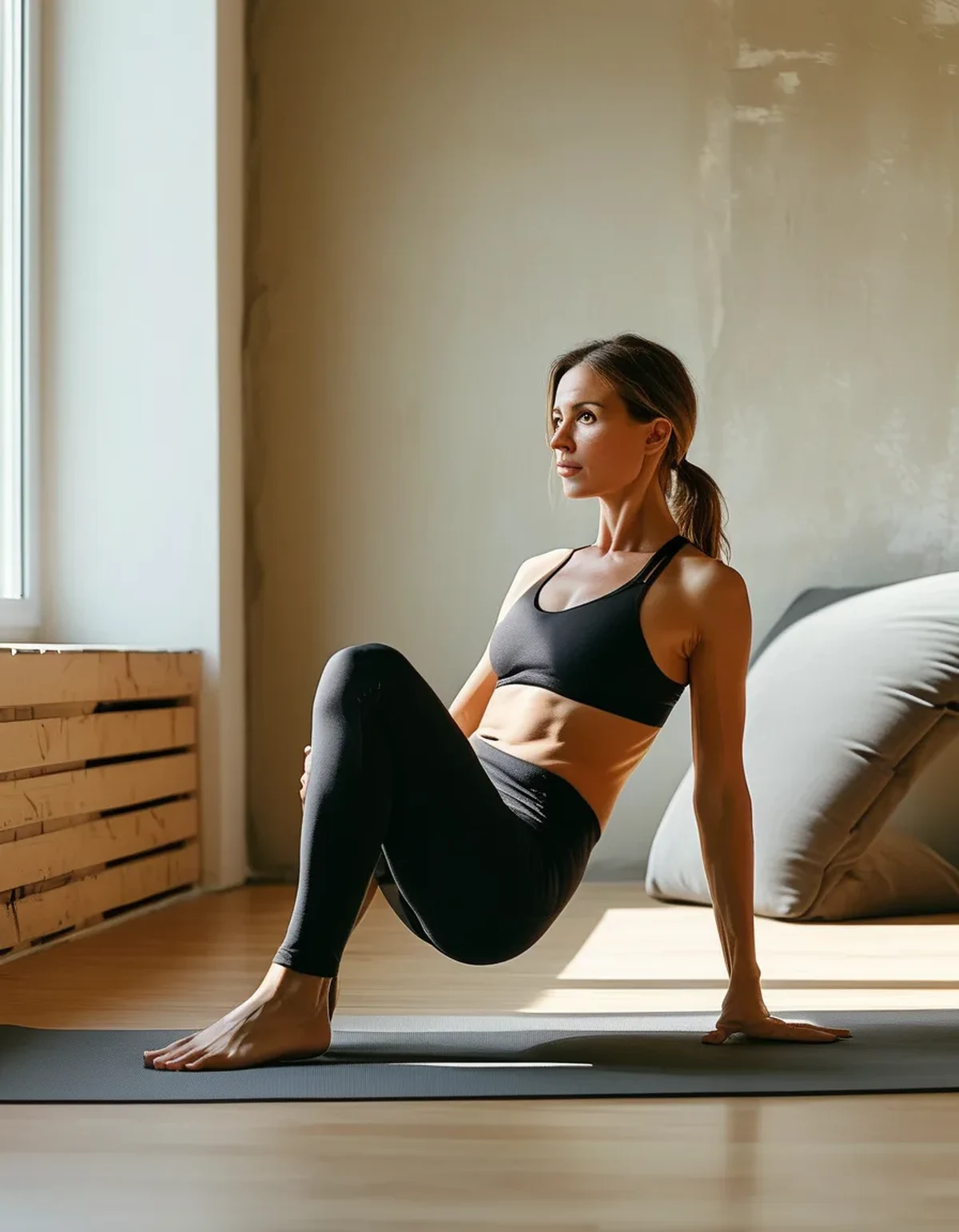
Seen here: Bootcut Capri Yoga Pants with Pockets — shop similar styles on bubblelime.com
Keep Reading
This article is for general informational and styling purposes only. Fit, sizing, and product availability may vary.