What to Do When Wall Pilates Starts Feeling Easy
Quick Answer: Bodyweight wall work progresses through leverage, time under tension, range, and stability rather than through added weight. When a routine gets easy, change one of those four variables rather than adding more repetitions. More reps of an easy movement builds endurance, not strength. Pick one variable and change it by a small amount.
The routine getting easy is the whole point of doing it.
It is also the moment it stops working, which nobody mentions in week one.

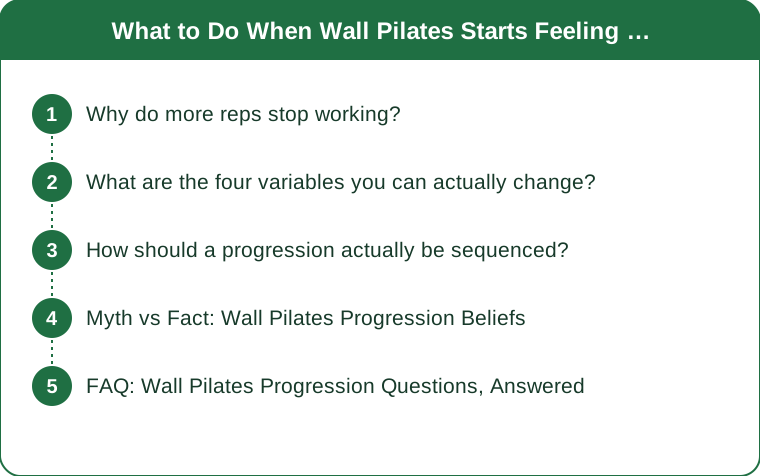
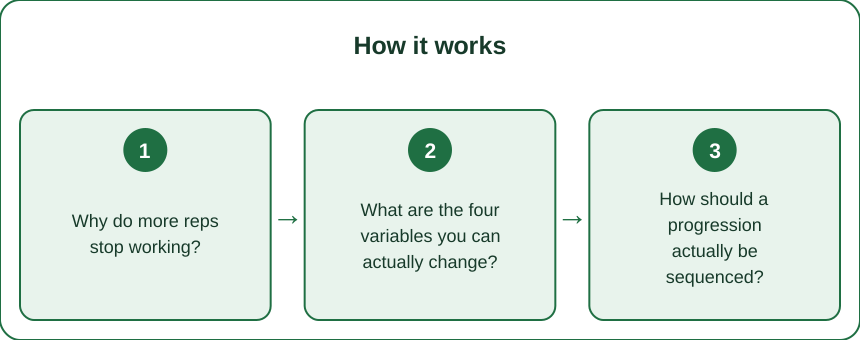
Why do more reps stop working?
Because repetitions and difficulty are not the same lever.
Strength adapts to challenge, not to volume alone. Once a movement is comfortably within your capacity, adding repetitions trains muscular endurance and does very little for strength. Both are worth having, but they are different goals and most people want the strength one.
Sets get long and boring before they get hard. Thirty repetitions of an easy movement takes minutes and produces mild fatigue rather than genuine challenge. Time cost rises much faster than benefit, which is how people end up with forty-minute sessions that achieve less than the original fifteen.
Form degrades in long easy sets. Attention drifts, the movement gets sloppy, and the technical quality that made wall work valuable disappears. The wall’s main advantage is feedback, and inattentive reps waste it.
Your nervous system adapts fast in the first weeks. A large share of early progress is learning the movement rather than building tissue. When the fast adaptation finishes, continuing unchanged produces a genuine plateau.
And the wall makes some movements easier by design. It removes balance demand, which is helpful at the start and becomes the limiting factor later. The support you needed in week one is holding you back by week eight.
Which is why progression has to be chosen. Nothing about a home routine forces you to make it harder. In a class the instructor does it; at home it is on you, and that is why home routines plateau more often.
What are the four variables you can actually change?
Leverage, time, range, and stability - and you change one at a time.
Leverage: move your base further from the wall. Increasing the angle of your body increases the load on the working muscles substantially, without changing the movement at all. Small changes in foot position produce large changes in difficulty, which makes this the most precise variable available.
Time: hold the hard position longer, or slow the movement down. A three-second lower is meaningfully harder than a one-second lower for the same repetition count. Slowing down is free, requires no new movements, and is the most underused option.
Range: go further into the position. Deeper bridges, lower wall sits, fuller extensions - within what you can control. Range is a real progression provided the added range is controlled rather than dropped into.
Stability: remove support. Single-leg versions, lifting an arm, or moving from two contact points to one increases demand dramatically. This is the biggest single jump and the one most likely to be too much, so use it last.
Change one variable at a time and give it two weeks. Changing three at once produces a session you cannot complete and no information about which change was too much. One variable, two weeks, then reassess.
And track it, however roughly. Foot distance from the wall, hold seconds, or reps at a slower tempo - one number written down. Progression without a record turns into repeating whatever felt fine last time.

How should a progression actually be sequenced?
Slowest and safest first, most demanding last.
Start with tempo, because it is the safest. Slowing the lowering phase adds difficulty without changing position, range, or balance demand. Three seconds down, one second up is a good first change and often enough for a month.
Then extend the holds. Adding five to ten seconds to isometric positions is measurable, easy to track, and low risk. Wall sits and bridges respond particularly well to this.
Then adjust leverage. Move the feet a few inches, which is small in absolute terms and large in effect. Change position by a little and test one set before committing a whole session to it.
Then increase range, provided you control it. Deeper positions demand more mobility as well as more strength, and forcing range you do not have is where discomfort starts. If the last few degrees feel uncontrolled, that is your current limit and it will move on its own.
Then remove stability, last of all. Single-leg work is a large jump and belongs after the other three are established. Expect a temporary drop in reps and holds when you make this change - that is what it is supposed to do.
And keep a deload week roughly every sixth week. Reduced volume for a week allows accumulated fatigue to clear and often produces a jump afterwards. Sharp pain, joint pain, or anything that persists between sessions means back off and get it looked at rather than progressing through it. This is general information, not medical advice.
Myth vs Fact: Wall Pilates Progression Beliefs
Myth: if it is not burning, it is not working. Fact: the burn tracks metabolic fatigue rather than training quality, and slow controlled work can be highly effective with less of it. Burn is a sensation, not a measurement.
Myth: more repetitions is the natural way to progress bodyweight work. Fact: past around fifteen to twenty controlled reps you are training endurance. Change the difficulty instead of the count once sets get long.
Myth: you need equipment to keep progressing. Fact: leverage, tempo, range, and stability offer months of progression with nothing but a wall. Equipment is an option, not a requirement.
Myth: the wall is only for beginners. Fact: the wall provides feedback about alignment that is genuinely useful at every level, and single-leg wall work is difficult by any standard. Support and simplicity are not the same thing.
Myth: you should feel it in the same place forever. Fact: as technique improves, the load distributes differently and the sensation moves. A changed sensation often means better form, not a lost exercise.
Myth: a plateau means you need a new programme. Fact: most plateaus are one unchanged variable, not a failed programme. Change one thing before changing everything.
FAQ: Wall Pilates Progression Questions, Answered
How do I know when it is time to progress?
When you finish a set and could clearly do several more with good form, or when a hold no longer requires real attention. Comfortable completion is the signal.
How much harder should each step be?
Small enough that you can still complete the session with good technique - roughly a change that costs you a few reps or a few seconds. If it halves your numbers, it was too big a jump.
Should I add weight instead?
You can, but leverage and tempo usually offer more room than people expect before weight becomes necessary. Exhaust the free variables first - they are more precise and easier to reverse.
TL;DR:
- Adding reps to an easy movement builds endurance, not strength - the count is the wrong lever.
- Four variables progress bodyweight work: leverage, time under tension, range, and stability.
- Change one at a time and give it two weeks before deciding whether it worked.
- Sequence it safest first: tempo, then holds, then leverage, then range, then single-leg last.
- Write one number down - foot distance or hold seconds - or the progression quietly stops.
This week, slow your lowering phase to three seconds and leave everything else alone. Same routine, same time, and it will feel like a different session.
See It in Motion
Seen here: High Waist Bootcut Yoga Pants with Pockets — shop it on bubblelime.com
Keep Reading
This article is for general informational and styling purposes only. Fit, sizing, and product availability may vary.