Why Wall Pilates Feels Easy for 20 Seconds and Brutal at 45
Quick Answer: Wall Pilates isolates muscular endurance by removing the balance demand that normally lets you shift and cheat. Standing exercises let you micro-adjust constantly, which redistributes load; a wall pins your position and forces the same muscles to hold continuously. That is why a position that looks easy becomes very hard between 30 and 60 seconds, and why time under tension is the variable that matters most here.
You see the position, you think you know how it will feel, and then second 38 arrives and changes your mind entirely.
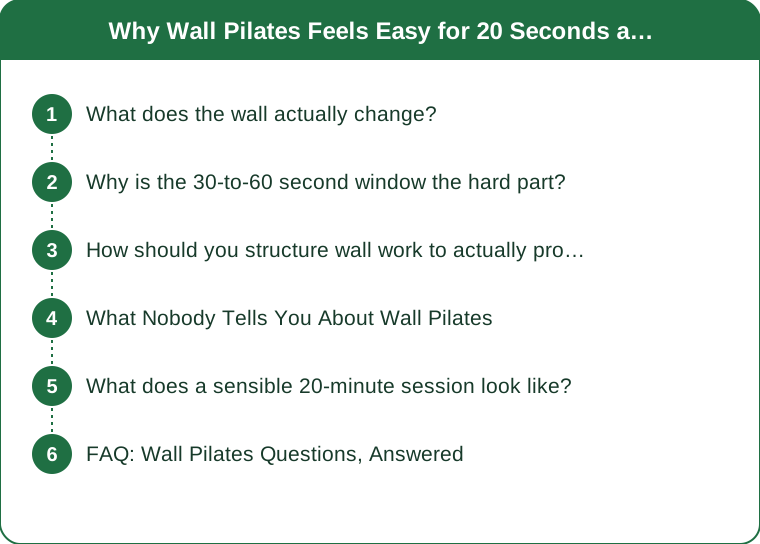
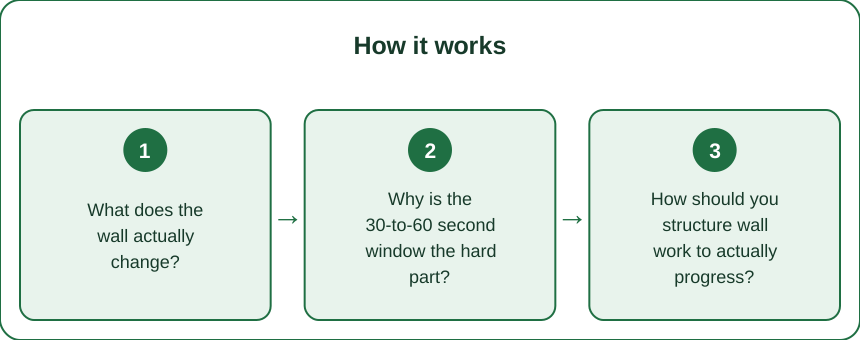
What does the wall actually change?
It removes degrees of freedom. In a standing exercise, your body constantly makes small corrections — a shift of weight, a slight change in hip angle, a subtle recruitment of a different muscle. Those corrections feel like balance, but functionally they are rest.
A wall fixes your spine, pelvis, or feet in place depending on the exercise, so those micro-rests are unavailable. The same muscle stays under continuous tension for the whole hold instead of trading off with its neighbors.
Continuous tension restricts blood flow within the working muscle, which accelerates metabolite build-up. That is the burning sensation, and it is why the difficulty curve is so steep rather than linear.
Why is the 30-to-60 second window the hard part?
Because that is where your energy systems change hands. The first 10 to 15 seconds run largely on stored phosphocreatine, which is immediately available and requires no oxygen.
After that, glycolysis takes over, and its byproducts accumulate faster than a muscle held in isometric contraction can clear them — the sustained contraction itself is restricting the blood flow that would do the clearing.
This is why isometric holds have a characteristic feel: fine, fine, fine, then suddenly not fine. It is not a mental failure at second 38. It is a measurable physiological transition.
Training it works, though. Repeated exposure improves both buffering capacity and your tolerance for the sensation, and most people can extend a hold by 50 percent within a few weeks.
How should you structure wall work to actually progress?
Time under tension is your primary variable, and it should progress deliberately rather than by feel.
A workable progression: three sets at your current failure point minus 5 seconds, three times a week, adding 5 seconds per week. Stopping just short of failure on most sets produces better weekly progress than going to failure every set, because it keeps quality high across all three.
The second variable is lever length. Extending your arms overhead in a wall sit, or moving your feet further from the wall, changes the demand substantially without adding time.
The third is tempo within the movement portions. A wall roll-down done over 8 seconds is a different exercise from the same movement done over 3.
Add load last. Holding a light weight during a wall hold is effective, but position quality degrades quickly, and a wall exercise done in a broken position loses the specificity that made it useful.
What Nobody Tells You About Wall Pilates
The wall itself is a variable, and nobody mentions it. A textured or painted wall provides grip; smooth tile or glossy paint lets your back slide, which changes the exercise into a much harder one and often into an unsafe one.
Socks are the other silent variable. Wall work on a smooth floor in socks is how ankles get hurt, and the fix is bare feet or grip socks rather than a different exercise.
The thing that surprises people most: wall work leaves marks. Sustained back contact with a painted wall transfers oils and sweat, and it shows within a few weeks on a light-colored wall. A towel between your back and the wall solves it entirely and costs nothing.
And there is a breathing point almost nobody makes. The instinct during a hard isometric hold is to brace and hold your breath, which raises blood pressure sharply. Steady breathing through a hold is both safer and, counterintuitively, lets you hold longer. If you have blood pressure concerns, this matters more than the exercise selection does — general information, not medical advice, and worth a conversation with a professional.
One more: wall Pilates is unusually good for small spaces because the wall is the equipment. There is no version of this that requires you to clear a room.
What does a sensible 20-minute session look like?
Start with two minutes of mobility — hip flexors and thoracic spine, both of which limit wall positions more than strength does.
Then three blocks. A wall sit variation for lower body endurance, a wall push or plank variation for upper body, and a wall roll-down or bridge series for spinal articulation. Three sets each, working in the 30 to 60 second range.
Finish with something dynamic — marching or leg slides — so you leave the session having moved rather than only held.
Twenty minutes done three times a week outperforms 50 minutes done once, because isometric endurance responds to frequency more than to session length.
FAQ: Wall Pilates Questions, Answered
Is wall Pilates real Pilates?
It borrows Pilates principles — control, precision, breath, core engagement — and applies them with a wall as feedback and support. Purists distinguish it from mat and apparatus work; functionally it is a legitimate and accessible variation.
Will it build strength or just endurance?
Primarily endurance and control at the joint angles you train. Isometric training does build strength, but the gains are relatively specific to the angle held, so vary your positions.
How sore should I expect to be?
Isometric work at long durations produces real soreness, especially the first few weeks. Sharp joint pain during a hold is different from muscular burn and is a reason to stop and reassess the position.
TL;DR:
- The wall removes the micro-adjustments that normally give muscles brief rest.
- The 30-to-60 second wall is an energy-system transition, not a willpower failure.
- Progress with time under tension first, lever length second, load last.
- Grip socks, a towel on the wall, and steady breathing solve most practical problems.
Wall Pilates gets dismissed as a gentle option by people who have never held a proper wall sit with arms overhead for 45 seconds. Try that once and the category re-sorts itself.
See It in Motion
Seen here: High Waist 8” Yoga Shorts — shop similar styles on bubblelime.com
Keep Reading
This article is for general informational and styling purposes only. Fit, sizing, and product availability may vary.