Why Wall Pilates Feels Harder on Carpet Than Hard Floor
Quick Answer: A soft surface deforms under load, so your feet and hands sink unevenly and the base you are balancing on keeps changing shape. That makes stabilising muscles work harder and makes precise alignment much more difficult to hold, which is why the same sequence feels wobblier and more fatiguing on carpet. It is not automatically worse - the instability trains balance - but it does make alignment-critical positions harder to do correctly, and it changes how much your feet grip against the wall.
You moved into the carpeted room because the kitchen floor got cold.
Same sequence, same wall, and suddenly your standing leg is doing something it never used to do.
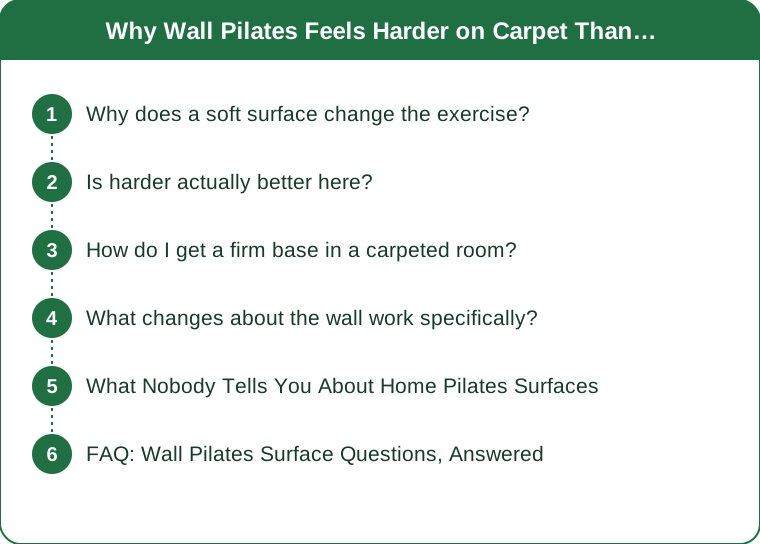
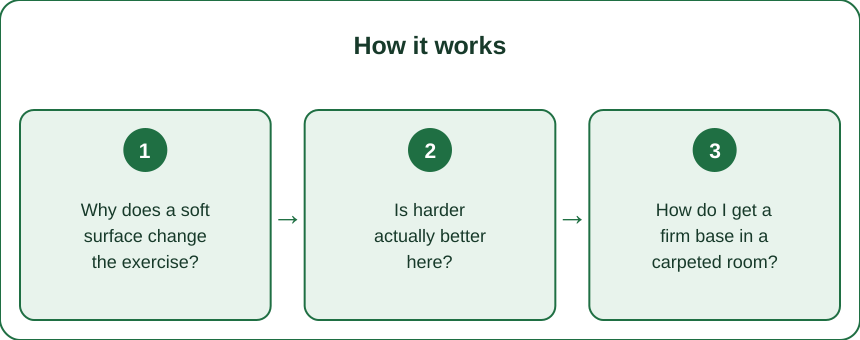
Why does a soft surface change the exercise?
Carpet compresses under pressure and rebounds slowly, so the base under your foot or hand is moving while you are trying to hold still.
Compression is uneven. More weight on the heel means the heel sinks further, which tilts the foot and changes joint angles up the chain.
Your stabilisers work continuously to correct that, which is why the fatigue arrives sooner and feels different.
Proprioceptive input changes too. A firm floor gives clear feedback about where you are; a soft one blurs it.
The wall becomes more important as a reference, since it is the only fixed surface in the setup.
Which is why the same sequence can feel like a harder class without anything else changing.
Is harder actually better here?
Not automatically. More difficulty from instability is not the same as more benefit, and it depends on what the exercise is for.
For balance and ankle stability work, instability is useful, and a softer surface is a legitimate progression.
For alignment-focused work it is a hindrance, because you cannot hold a precise position on a base that keeps changing.
Wall pilates depends heavily on alignment, since the wall is there to give you a reference plane to work against.
Strength-focused positions suffer most, as force leaks into stabilising instead of into the target muscle.
So the sensible approach is a firm base for alignment and strength work, and to add instability deliberately when balance is the goal.
How do I get a firm base in a carpeted room?
A thin, dense mat beats a thick soft one. Thickness feels kinder to the knees and makes stability worse; density is what you actually want.
Put a hard board or a folded exercise mat under the working area for standing or single-leg positions.
Use a 4 to 6mm dense mat rather than a 10 to 15mm cushioned one for anything alignment-critical.
Keep a folded towel for knees rather than solving knee comfort with the whole mat, which is the trade most people get backwards.
Check the mat is not sliding on the carpet pile, which is a separate problem and a genuine hazard for wall work.
And place the mat so it does not fold or ruck against the skirting, since a ridge at the wall changes foot placement on every rep.

What changes about the wall work specifically?
Foot placement against the wall becomes less stable when the surface under your other foot is soft, so positions drift.
Wall sits are affected less than single-leg work, since both feet share the load and the wall carries the back.
Bridge and hip work are affected more, because the feet need to push into a firm surface to generate force.
Push-off force leaks into the carpet rather than transferring, which is why bridges feel less effective on soft ground.
Marking foot position with tape or a mat edge helps a great deal when the surface gives no natural reference.
And a wall with a smooth clean surface matters more on soft ground, since the wall is doing more of the stabilising.
What Nobody Tells You About Home Pilates Surfaces
Thicker mats are usually the wrong purchase. The marketing suggests more cushioning is more comfortable and better for joints, and for floor-based mat work on hard floors that is partly true. For anything standing, single-leg or alignment-focused, a thick soft mat actively degrades the exercise. Most experienced practitioners use thinner, denser mats than beginners do.
The wobble is not always a weakness signal. People conclude they have lost balance or core strength when they move to a carpeted room. The base changed. Testing the same position on a hard floor before drawing conclusions about your own progress is worth doing.
Sock choice matters more on soft surfaces. Grip socks are useful on hard floors and even more useful on carpet-plus-mat setups where slipping has two possible interfaces. Plain socks on a mat on carpet is genuinely the least stable common combination.
Cold hard floors are worth solving with heating, not with soft surfaces. People move to carpeted rooms in autumn for warmth and inherit a stability problem. A rug over the hard floor for warmth, with a firm mat on top for the work, keeps both.
The wall is not always a wall. Plasterboard with a hollow behind it flexes under a hard push, which changes the feedback in exactly the same way a soft floor does. A load-bearing wall or one with a stud behind the contact point gives a much better reference, and it is worth finding out which is which in your room.
And surface variety has genuine value over a training block. Doing everything on one perfect surface trains one narrow pattern. Alternating - firm for alignment and strength, softer for balance and ankle work - covers more, provided the choice is deliberate rather than accidental.
FAQ: Wall Pilates Surface Questions, Answered
What thickness mat is best for wall pilates?
Around 4 to 6mm and dense. Thicker mats add cushioning at the cost of the stability that standing and single-leg work depends on.
Can I do wall pilates directly on carpet?
Yes for floor-based work. For standing and single-leg positions, a firm mat or board on top of the carpet gives a much better base.
Why do my feet slip on the wall?
Usually dust or paint sheen on the wall, or socks. Grip socks or bare feet and a wiped wall solve most of it.
Is a softer surface better for my knees?
A folded towel under the knees solves knee comfort without making the whole base unstable, which is the better trade.
Does the wall type matter?
A solid or stud-backed wall gives firmer feedback than hollow plasterboard, which flexes slightly and blurs the reference.
Should I train on an unstable surface deliberately?
For balance and ankle work, yes, as a deliberate progression. For alignment and strength positions, a firm base gives better results.
This is general information, not medical advice.
TL;DR:
- Soft surfaces compress unevenly, so the base under you keeps changing shape and stabilisers work continuously.
- Harder is not automatically better - instability helps balance work and hinders alignment and strength work.
- Use a thin dense mat (4-6mm), not a thick cushioned one, and a folded towel for knee comfort.
- Bridges and hip work suffer most on soft ground because push-off force leaks into the carpet.
- Hollow plasterboard flexes like a soft floor; a solid wall gives a much better reference.
The wobble was the room, not you.
See It in Motion
Seen here: UPF 50+ Racerback Yoga Tank Top — shop it on bubblelime.com
Keep Reading
This article is for general informational and styling purposes only. Fit, sizing, and product availability may vary.